
Written by: Rachel Kwek Edited by: Alena Siaw
Ratatouille: How Subtle Politics in Film Shapes Us
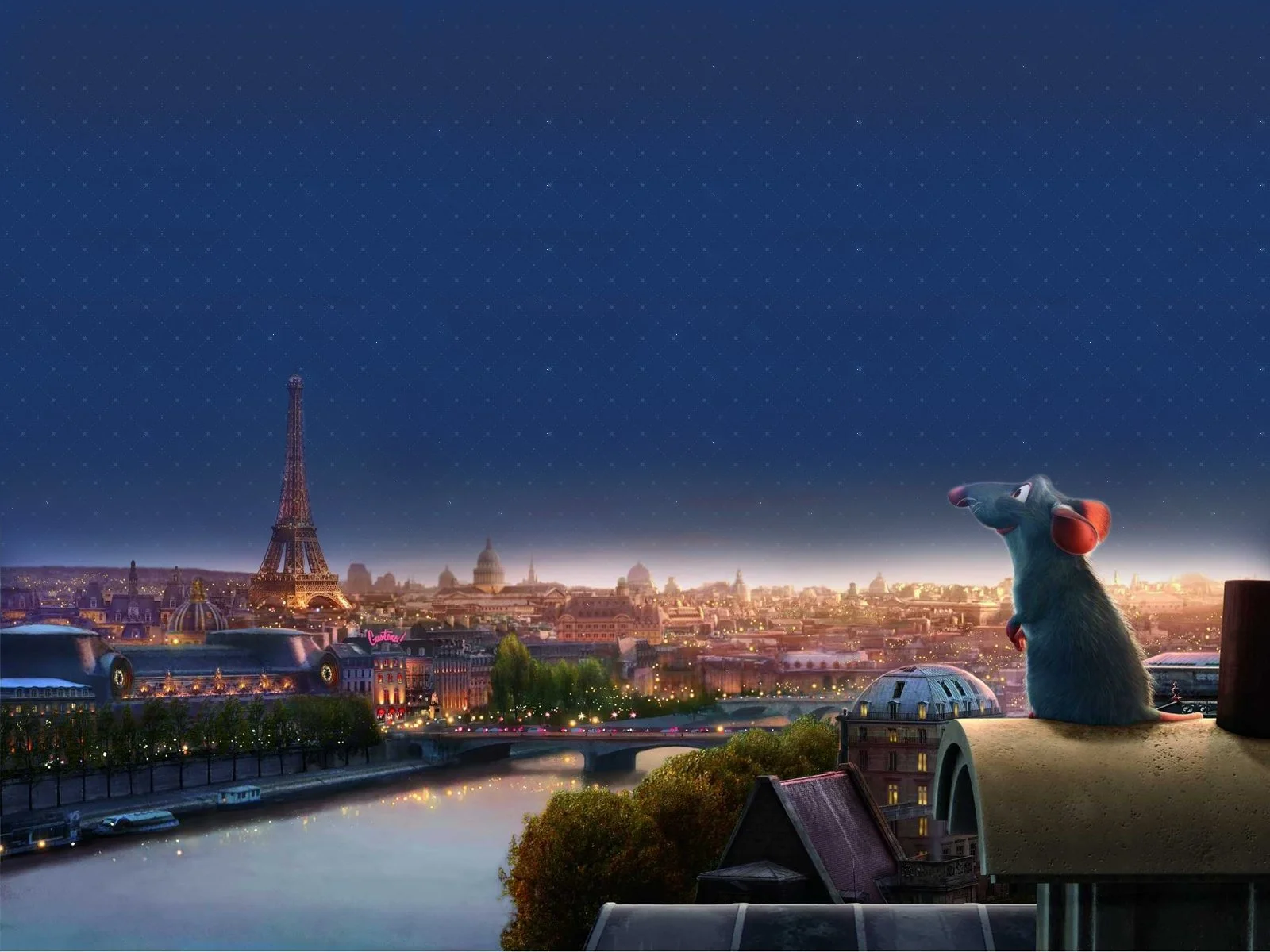
One of Ratatouille’s most memorable, widely lauded scenes is Remy’s discovery of the haute cuisine kitchen. Stranded from his family after an intense escape through the Parisian sewers, Remy emerges alone into the city above and climbs to a rooftop, where he first glimpses the illuminated grandeur of Gusteau’s restaurant. This moment, a seemingly innocuous turning point for the movie, cannot help but resonate intimately with its viewers. After all, we see this as part of the film’s authentic portrait of talent and merit, undergirded by the aspirations of a rat who seeks his footing as a cook in a high-end restaurant. Yet, what brews beneath the surface of this simplistic children’s movie offers so much more than what meets the eye: a sardonic, uncomfortable reflection on classist poverty. These parallels cannot be dismissed as mere coincidence. Subtle politics in film dominate society, whether we are cognisant of its existence or not. In this article, I contend for the timeless influence that subtle politics in film holds, as it still speaks truth to the events that pervade our lives today. Most saliently, the very nature of the films themselves also serves as a breeding ground for political theories and ideals to grow. In particular, the unique position of Ratatouille lies in its ideological struggle, where anti-capitalist critique somehow finds its place within corporate production. Lastly, I maintain the position that the features of subtle politics are not incorrigible; in fact, when mobilised to educate, these films can incite the contesting of norms and unethical behaviour as we read against the grain of subtle politics.
Covert politics in film?
The concept of “subtle politics” itself petrifies. How can we detect political theories that hide behind a film’s smokescreen? The chasms between subtle and blunt politics are dependent on their respective ability to trigger a viewer’s intellectual defences. When we watch a film that is beset by turbulent circumstances, from the upfront, violent policing in “A Taxi Driver” to the consumerist upheaval in “Wolf of Wall Street”, we unconsciously acknowledge their direct and blatant ideology. Our intuition encourages us to connect films to their historical context or fictional characteristics, hence drawing a line between what we believe in and what the film pushes for. In fact, films that explicitly state political intentions or offer didactic lessons often risk becoming propaganda, trivialising political reality, or conforming to ideology. In contrast, other forms of political art have “migrated into autonomous art, and nowhere more so than where it seems to be politically dead.” A foundational critique stemming from this perspective would dismiss a mass cultural product, such as a Disney film, as a vehicle of the cultural industry. This view thus similarly dismisses Ratatouille as merely affirmative culture, incapable of offering a genuine negation of reality and designed to reinforce the status quo. However, recognising the contradiction between the film’s nature as a corporate product and the anti-capitalist ideals it champions is exactly what makes such films so interesting to dissect. By implicitly critiquing existing social conditions from the structure in which the film is accessed, they can compel a change in attitude without resorting to didacticism or overt political slogans.

Ratatouille’s lens on class and capital
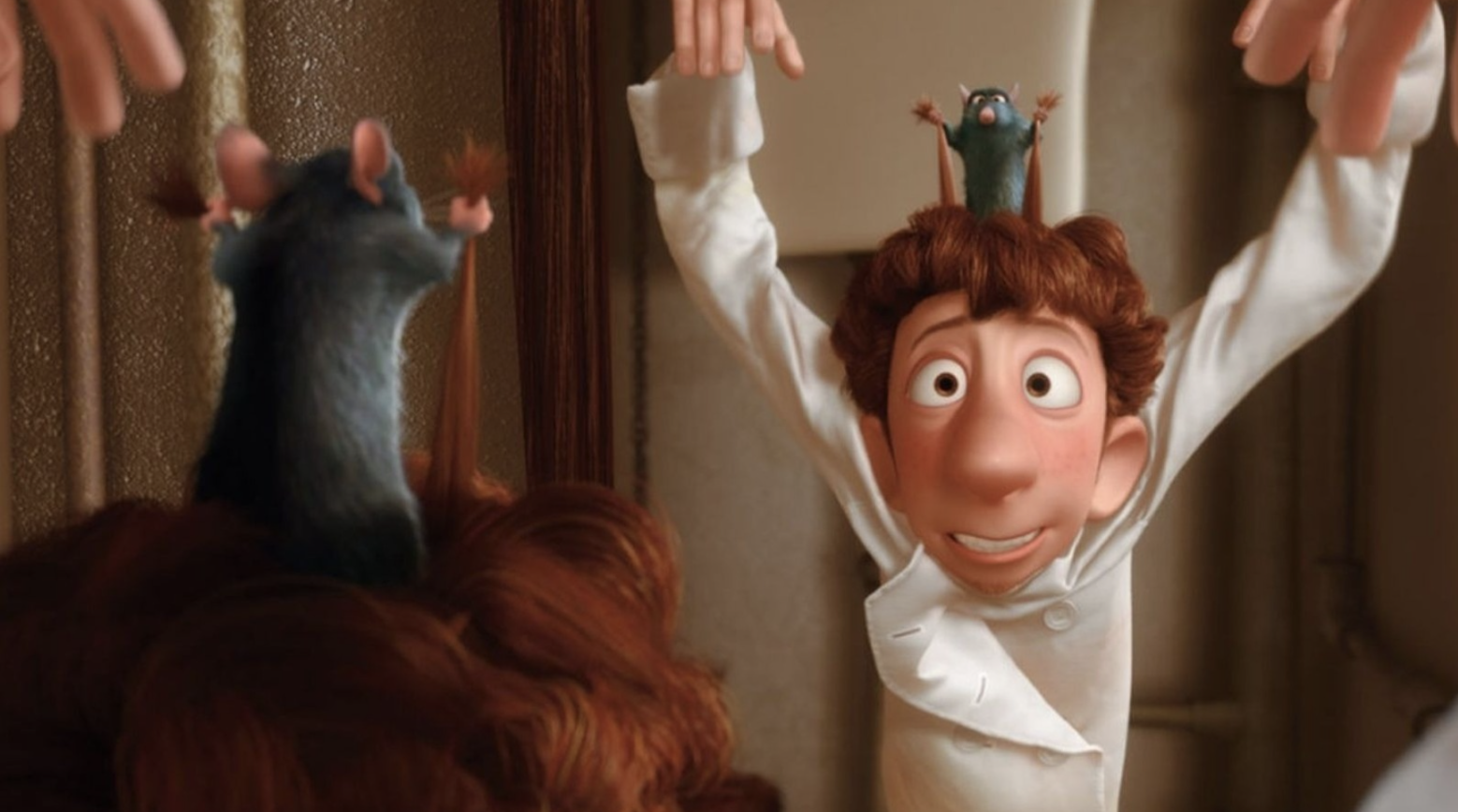
The storyline itself of Ratatouille does a commendable job of spreading political rhetoric under the guise of family-friendly entertainment. Viewers close in on the life of Remy, a rat who dreams of becoming a chef at a high-end restaurant located in Paris. He forms an alliance with Alfredo Linguini, the unskilled kitchen boy, where they work together to perfect a dish to impress the restaurant’s harsh food critic. The idea that “anyone can cook” permeates the entire film, reforming the traditional norms of success, and that even a rat that people typically see as vermin can become a revered chef. Remy’s backstory explores scavenging through heaps of garbage to find food and materials to repurpose into kitchenware. He looks for saffron in a human home, and upon discovery, is ousted from his clan’s home. Remy represents poverty and the meritocratic ideal: he highlights the working class struggles and that despite this, he can be emancipated from systemic poverty given that he leverages his cooking talents and hard work. Moreover, the systemic obstacles are heightened when head chef Skinner is introduced: upon discovering that Linguini has a claim to the restaurant as the original owner’s son, he devises a plan to fire Linguini and keep his position. His lawyer advises that after three days, the deadline for Linguini’s claim will pass, and Skinner can fire him without arousing suspicion. We are angered by Skinner’s hubris, but it only contributes to the larger picture of the capitalistic approach. Similarly, the wealthy elite orchestrate conditions to cut the social mobility of the poor. At the end of the day, the poor only become poorer, and dreams spiral into a collective abandonment.
The nexus between animation and reality
Indeed, it’s not unreasonable to suggest that Ratatouille behaves as a microcosm of our world. Today, the flames of inequality are raging; just this year alone, the top 10% of earners in the U.S. owned almost two-thirds of total wealth, while the bottom 50% owned just 2.5%. Economic insecurity, exploitative working environments, and unethical slashed funding simply evidence the turmoil of our society. The case of the 31-day boycott of Amazon launched in July 2025 hits closer to home, spearheaded by People's Union USA and echoed by labour advocates and consumers. Amazon stood accused of driving workers to the edge through a cornucopia of surveillance and unethical quotas. The extreme working conditions and corporate greed drew parallels to the control and standardisation touted by capitalism. This widespread disillusionment reveals a growing awareness that the promises of capitalism are failing many, which Ratatouille points out in its critique of the capitalist system. Merit, though positively reinforced in the movie, remains the backbone of a deeply divisive system, given today’s exploitation of insubordinate labour and the non-linear relationship between income and working hours. Despite the attempts to present the positives of meritocracy in Ratatouille through Remy’s success, the movie’s depiction of Skinner’s bullying and systemic barriers acts asa constant impediment, diminishing the capability of merit in always being able to achieve positive outcomes. Ratatouille, therefore, forces us to stare down the barrel, to recognise the failures of the system we live in.
Children’s media as a vehicle for conditioning
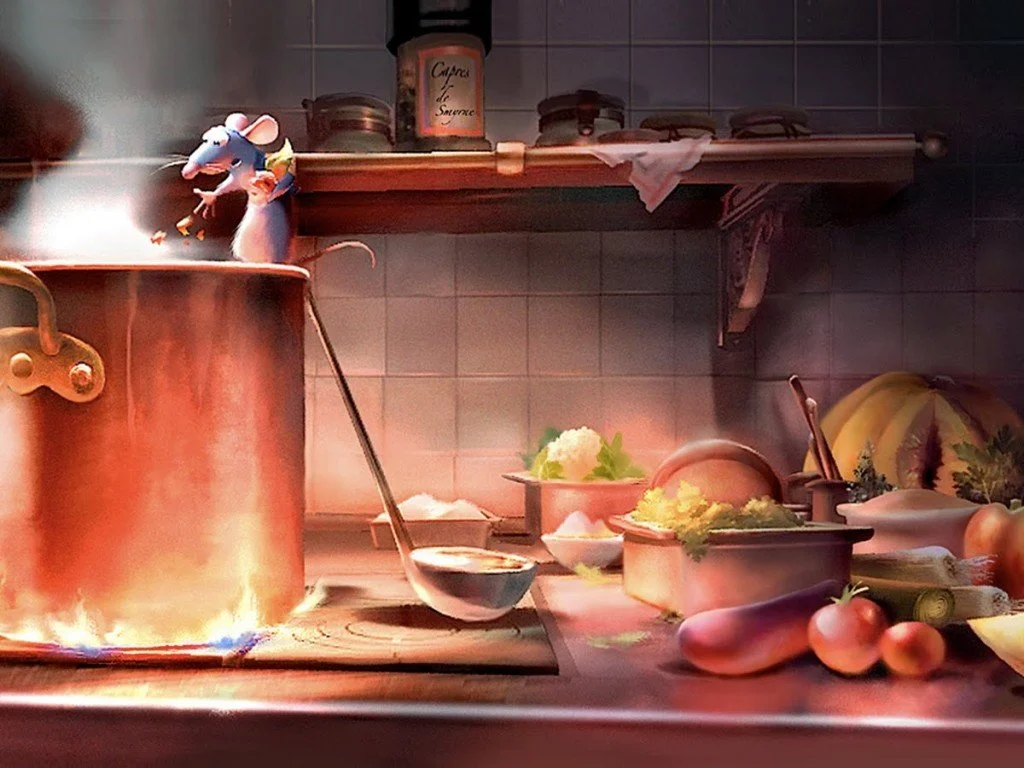
At its core, Ratatouille is still a film made for children. Animations that we grow up watching function as cultural touchstones and are bound to shape our social and ethical tendencies before we even realise. Not only do children mistake Ratatouille for not meaning any more than culinary ambition and rooting for the underdog, but they also lack the tools to identify and deconstruct its underlying political potency. Furthermore, children’s media is never ideologically neutral; it often encodes dominant societal narratives. The charming, kiddish animations in Ratatouille portray an idealised world where even a mere rat can become a celebrated chef, presenting an “image of the qualitative difference” where talent and passion transcend traditional boundaries. This imaginative freedom injected into the film, through its detailed and expressive animation of food and Paris, prompts children to consider alternative realities or question fixed social hierarchies, such as who is “allowed” to be a chef or who belongs where in society. In this way, Ratatouille shows an unpledged commitment to “truth in its own aesthetic form” by embedding its messages in striking animated visuals. Thus, the very fact that Ratatouille is a film made for children is leveraged on as a vehicle for its political depth because its messages are inescapable.
To read against the grain
The danger of subtle politics is now apparent, yet the phrase that “all art is political” may not be as tragic as it seems. Even if our films are not value-free, they provide us with the opportunity to transform our wariness of subversive messaging into a nuanced and active understanding of the world. Parents can leverage children’s movies as innovative pedagogical tools by questioning the ethics of decisions made by the characters. In this case, Ratatouille can be developed as an entry point into discussions of merit and class divide without seeming overtly didactic. Questions such as “why couldn’t Remy be a chef?” can use the movie as a springboard for dialogue and unpack its underlying metaphors in an accessible way for children. Rather than seeing politically charged films as scheming or letting their ideas slip past us as passing thoughts, we can therefore use these films to reach more productive ends.
In conclusion, while subtle politicising in films carries the risk of unexamined influence, it also presents a valuable opportunity for critical engagement. Viewers ought to remain vigilant by actively interrogating political messaging, especially in children’s films, so that they can transform potential sources of manipulation into meaningful education. Thus, we can be aware of the fragile promises that may misguide us, to sieve out biases and to remain vigilant but active in debunking the subtle politics that shape us.